
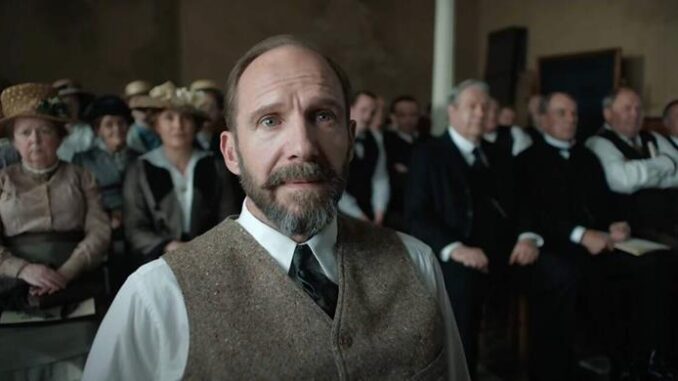

As it takes many voices to make a choir, it takes a community to make good music. Directed by Nicholas Hytner and written by Alan Bennett, The Choral unfolds in the fictional mill town of Ramsden, Yorkshire, where a local choral group and its eccentric new choirmaster Dr. Henry Guthrie work together to perform Elgar’s The Dream of Gerontius as a means of consolation against the hollow void brought on by World War I.
Themes of post-war recovery through music and love are a popular trope in theatre. Bennett’s The Choral, however, distinguishes itself in that the narrative is set in 1916, at the height of World War I, not in the aftermath of conflict but in the very midst of it.
The Choral sheds light on those left behind after the conscription of male soldiers—women waiting for news in uncertainty and young boys waiting for their draft notices. Ramsden is left deeply steeped in heavy silence and a sense of absence. When even the local choirmaster enlists, the future of the choral group hangs by a thread until they appoint Dr. Henry Guthrie, a man as talented as he is shrouded in secrets.
This historical drama is undeniably committed to period authenticity. It’s evident in the old stone buildings, bricks, modest interiors, military uniforms, female costumes, and beautiful village landscapes. The Choral not only gives a warm Yorkshire mise-en-scene but also displays authentic choral performances. The raw and beautiful voices of the actors and their amateur-style singing are well-featured.
Throughout the film, Guthrie is faced with suspicion and mistrust because he has lived in Germany for many years. This unease turns aggressive along with the choir’s rehearsal of St. Matthew Passion —by Bach, a German composer— a brick breaks through the audition room, “Hun muck” written on it. In response, the choral group practices Elgar’s The Dream of Gerontius. From pubs to the military hospital, Guthrie roams everywhere possible to find new male voices for the choir.
This film’s ending is where the film’s intentions crystallize most clearly. Within the newly assembled choral group, music serves conflicting purposes. For some members, it provides sanctuary, a means of endurance and recovery in the shadow of war. For others, it’s a space of desire and distraction. Each character carries a different story, and this film embraces this unevenness by depicting young boys dreaming of their first sexual experience before enlistment and women tentatively looking for new love. There is even a love triangle; I liked it when Bella’s romance with a young man gets complicated by the sudden return of her husband.
It is the new choirmaster Guthrie who must hold these disparate lives together. Yet the dark humour also extends its ends towards him. His atheism and homosexuality make him a radical outcast in the town. His line of “I want you to see me” exerts powerful force. In this way, the choral group becomes more than a musical ensemble, and it offers shelter for everyone. Ralph Fiennes does a wonderful job of balancing the contrast between Guthrie as a choirmaster and Guthrie as an isolated individual with some sense of subtlety. The Choral leaves us with a bittersweet aftertaste that makes us think back long after the ending.
The basics of choral music include individual singers blending their unique sounds to form a collective harmony. Perhaps that is the understated thesis of The Choral that in times of loss, meaning is found in a collective effort to move on.

