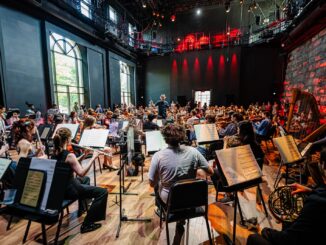

If you’re a classical music lover like I am, then you probably know how much “high quality” concerts usually cost. Well, what if I told you that the Orchestre de la francophonie is offering some beautiful free concerts in Montreal this summer? Definitely a dream come true for me. This year, the OF, celebrating its 25th anniversary, is presenting five unique concerts (three of which are free!) at different venues in Montreal, including an outdoor stage, a circus, and the prestigious Montreal Symphony House, the OSM’s concert hall.
For the OF’s 2026 season, conductor Julien Proulx has taken up the role of artistic director, sharing his passion for music with a full orchestra of talented young musicians aged 18 to 30 from all around the world, for six weeks. A perfect opportunity for aspiring professionals to experience what it’s like to play in an orchestra. Every couple of weeks, the musicians start a new concert program, with pieces ranging from Stravinsky’s challenging Firebird to Brahms’ Fourth Symphony, one of Proulx’s personal favourites to conduct. The diverse repertoire also includes pieces by Québécois composer Pierre Mercure, French composer Louise Farrenc, contemporary works, and two new pieces by young local composers.
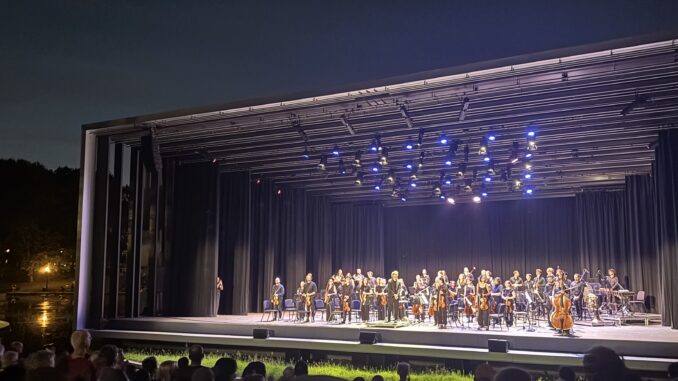
I attended the OF’s opening concert, Kaléidoscope symphonique, on July 4 at the Théâtre de Verdure, a breathtaking outdoor venue located in Parc La Fontaine. What an experience! The packed rows of spectators sitting in awestruck silence as the sounds of nature start mixing with the music, the flute solo in Bizet’s Suite No. 1 from Carmen giving a voice to the birds flying across the stage. Then, Proulx presented Pierre Mercure’s Kaléidoscope, a tribute to francophone musicians, a vibrant piece full of rich layers of motifs, layers upon layers of unique sounds and colours creating a true musical kaleidoscope. I could only imagine what it sounds like to the conductor himself, who describes his work as “listening to multiple conversations.” I will say he has definitely succeeded in that; the music speaks for itself (pun intended).
The concert finale, Dvořák’s New World Symphony, tells Dvořák’s own story of leaving his homeland in Bohemia for a new life in America. The main melody of the second movement (which is probably familiar to musicians and non-musicians alike) was later given lyrics to become the beautifully nostalgic “Goin’ Home”. Each of the four movements of the symphony paints a different portrait of the “New World”, from glorious images of New York in the first movement, to nostalgia and hope in the second, from African and Native American inspired melodies in the third, to an earworm cowboy theme in the fourth.
Julien Proulx states that, as a conductor as well as a teacher and mentor for the young OF musicians, he seeks to “create a unit, a common sound, a common vision” with the orchestra. Dvořák’s story, in a way, becomes his and the orchestra’s story to tell, and our story to hear. Each of us “find[s] a truth in the work, our truth.” I believe that is the true beauty of classical music: it offers endless stories.
To find out more about upcoming concerts featuring the Orchestre de la francophonie, click HERE.