

The 31st edition of Festival Accès Asie brings together Asian artists across Montreal to represent and show the rich diversity of Asian heritage and diaspora!
Since its founding in 1995, the festival has commemorated Asian Heritage Month (May) in Canada with the purpose of raising Asian voices and overcoming underrepresentation of Asian artistry in mainstream arts. Again this year, Festival Accès Asie served as a huge stage for Asian artists, where they could present their personal stories of identity, culture, belonging, migration, and many more. It was a great privilege for me to be there and witness such a memorable moment of collective reinforcement.
Open Mic Asiatique
My very first encounter with Festival Accès Asie was Open Mic Asiatique on May 9th at the Maison de la culture de Parc-Extension. The event featured five amazing Asian artists and a number of open mic participants. Organized and hosted by Rich Ly and Claudia Chan Tak, it drew a full house, gathering about a hundred attendees into the lively atmosphere!
Foremost, dim lighting, garlands written “L’open Mic Asiatique”, colourful stage hues, and a compact arrangement of drums, guitars, and keyboards on stage fostered a cozy setup, making it almost feel like I was in a small jazz club or a local pub. I would not say that it was strictly an Asian-themed show, but the laid-back atmosphere was definitely what I was looking for. Open Mic Asiatique was primarily offered in French, led by two amazing MCs; their smooth and accurate transitions kept the evening moving at a fun pace. I loved their energy, they were hidden gems of the program.
The first hour and a half consisted of vocal performances and choreography with subtle Asian touches. I particularly enjoyed the fingerstyle guitar performance; when the musician skillfully went beyond adding layers by tapping the body of the guitar. The program was somewhat free in form and tone. After the music performances, several participants were able to join the stage and present their stories through music, body movements, dances, and even spoken words. Each articulated their cultural identity and character, and the rest of us were cheering for them. I liked the openness and flexibility of the setting and format. The artist-audience interaction was beautiful, as they were showing deep empathy for each other.
She and the other(s)
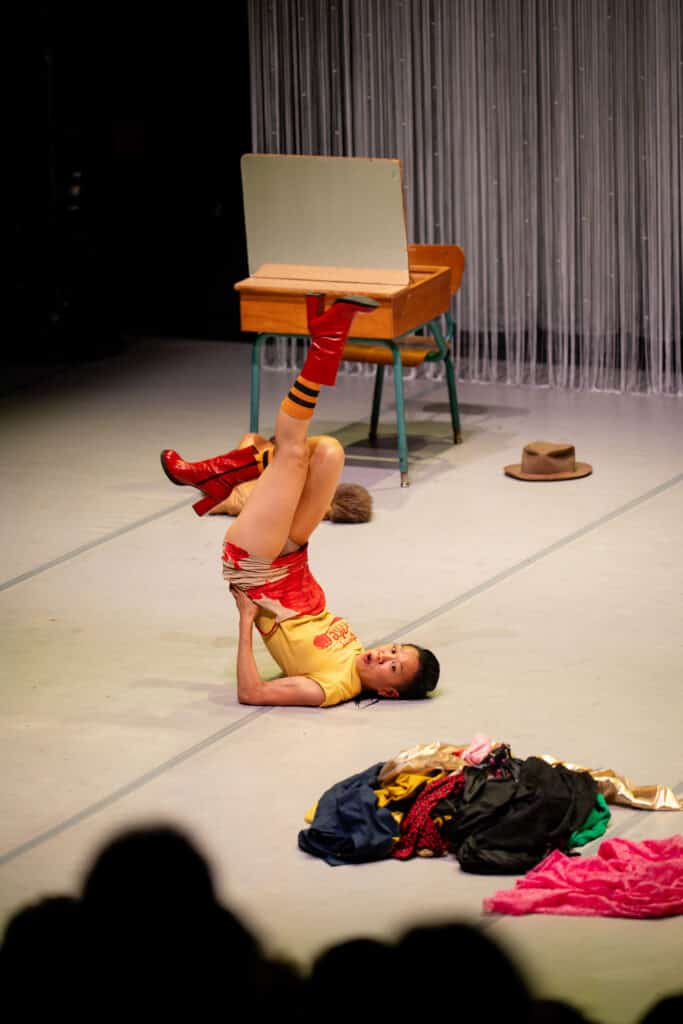
Chi Long’s She and the other(s), directed by Soeurs Schmutt and choreographed by Élodie Lombardo, captivated the hearts of the audience on May 15th at Maison de la culture Ahuntsic!
The solo performance features Chi Long, who addresses the deep-down trauma embedded in the process of defining cultural identity among multicultural communities. Autobiographical at its centre, the autofictional piece encompasses Long’s real-life experiences across three distinct cultural backgrounds: her Vietnamese heritage, upbringing in Australia, and migration into Quebec, with some fictional and borrowed elements to reinforce the theme of displacement.
At the theatre, what caught my eye was the clothing scattered across the stage, at first giving the impression of some sort of fashion installation rather than a traditional setting for performance arts.
Shortly after, it became very clear that each garment on the stage was to be used as an important narrative device. During the show, Long repeatedly dressed and undressed the clothes after each thematic sequence. Dresses, fabrics, and seemingly avant-garde bodysuits. By using costume changes as structural elements of her narrative, her narrative became more immersive and visually engaging to the audience.
In addition, her choreography beautifully expressed the transition of identity and character dynamics. Pop-and-lock-like gestures, contemporary dance sequences, unique postures, and ballet-core movements. To me, the combination of different dance styles symbolized the confusion and emotional fragmentation she had to go through due to migratory issues. References to the war and violence were also shown through aggressive gestures, guttural soundscapes, bold colours and hues.
Throughout the piece, Long references the idea of “deux personnages”, which represents her double-sided cultural identity. The concept appears both visually and auditorily within many aspects of this performance. Long illustrated the casual racism she experienced in her youth with some wit: “My parents gave me a simple name, Chi,” and she added sarcastically that in primary school in Australia, people even mispronounced this simple name. Long also recalled her parents saying, “You should become Australian, no longer Vietnamese.” The conflicting cultural expectations accordingly lead to an identity crisis, and what Long had to endure in between two worlds was vividly portrayed through the chaotic setting and raw choreography. The audiences seemed deeply immersed in the stage, and as an Asian immigrant myself settled in Quebec, I could also relate to everything the performance tried to bring to the table. I really enjoyed Long’s use of dark humour, which I believe contributed to the natural delivery of heavy themes.
Festival Accès Asie is still ongoing with many more talented artists to be discovered. I highly recommend taking the time to celebrate Asian Heritage Month with the rest of the lineup.
For details on the festival, click HERE. It continues until the end of May.